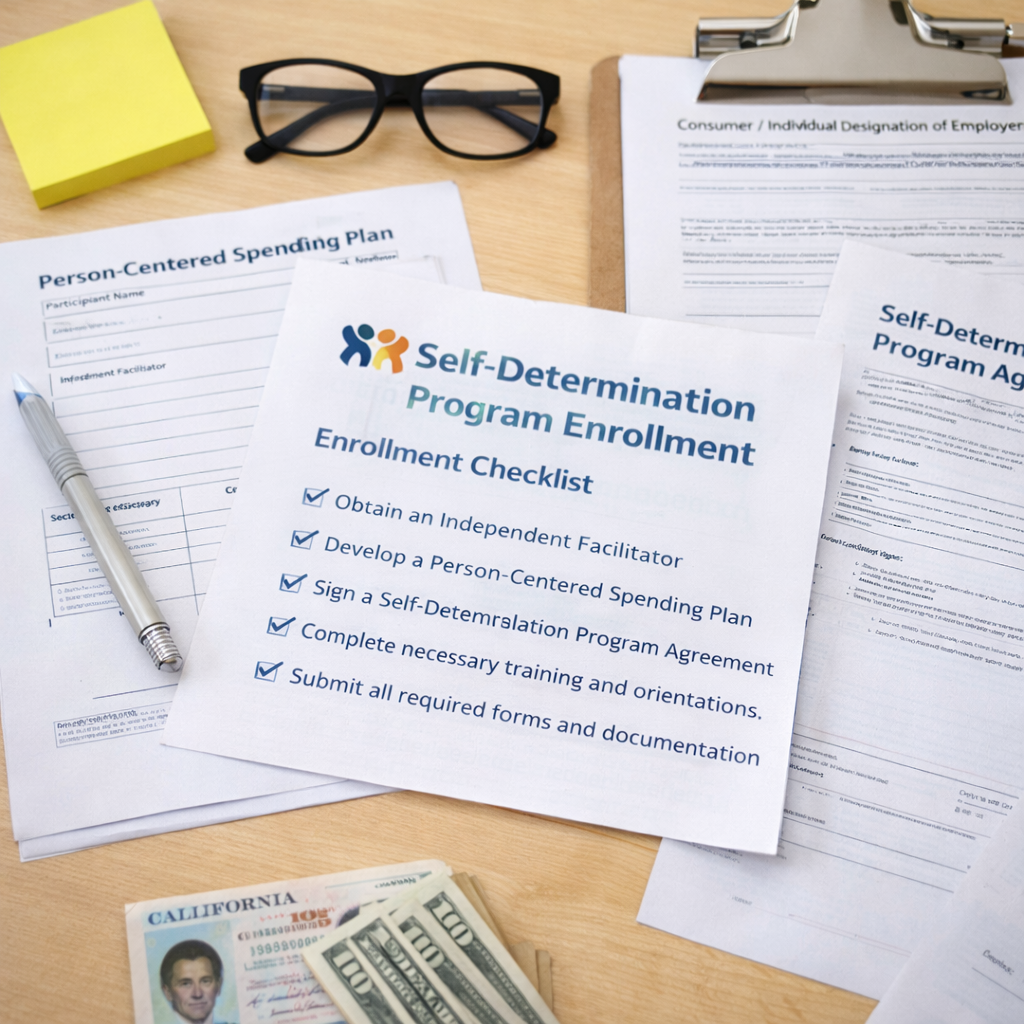
What Is the Self-Determination Program?
California's Self-Determination Program (SDP) is a voluntary alternative to the traditional Regional Center service model. Rather than having a service coordinator select and manage services on the participant's behalf, SDP gives families and individuals direct control over an individual budget — which they use to design and purchase the services that best fit their child's specific needs and life goals.
Participants work with an independent Financial Management Services (FMS) agency that handles the administrative and fiscal responsibilities, while the family retains authority over how the budget is allocated. Services can be self-directed — meaning the family hires and manages providers directly — or purchased through established vendors.
The result is a level of flexibility, personalization, and long-term planning capacity that the traditional Regional Center service model does not offer. For families who take the time to understand it, SDP is one of the most powerful tools available within the California special needs support system.
Who Is Eligible?
SDP is available to Regional Center clients who meet the following criteria:
- Active Regional Center enrollment with an established Individual Program Plan (IPP)
- Completion of SDP orientation and required training
- Development of a person-centered plan through an approved facilitator
- Selection of a Financial Management Services agency
There is no income test, no assets test, and no financial need requirement. Eligibility flows entirely from Regional Center enrollment and the completion of the program's orientation and planning requirements.
The Financial Misconception Most Families Have
Many families with the resources to navigate a more complex program structure assume SDP is designed for families who lack private means. This misreading of the program leads capable, organized families to remain in the traditional service coordination model when SDP would give them significantly more control and a better long-term outcome for their child.
What families with higher engagement levels gain from SDP:
- Direct authority over how the individual budget is spent — rather than relying on a service coordinator's recommendations
- The ability to hire providers who are not on the Regional Center vendor list, expanding access to specialists and programs that would otherwise be unavailable
- Greater flexibility to design services around the child's actual life goals rather than fitting the child into existing program categories
- Long-term planning capacity — SDP budgets and plans can be structured to evolve as the child grows and needs change
- The ability to build a support team that reflects the family's values and priorities, not those of a rotating service coordinator
SDP rewards preparation. Families who invest time in the person-centered planning process and understand how to structure their individual budget consistently achieve more for their child than the traditional model allows.
Common Mistakes Families Make
- Never learning about SDP because the Regional Center did not proactively explain it as an option
- Assuming the program is too complex to manage without adequate support and preparation
- Entering SDP without a well-developed person-centered plan, leading to budget misalignment
- Selecting a Financial Management Services agency without understanding the differences between available options
- Not coordinating the SDP individual budget with other active programs — Medi-Cal, IHSS, and CCS — to avoid duplication and maximize total support
How to Get Started
Enrollment in SDP begins with an orientation — offered by the Regional Center — that explains the program structure, responsibilities, and requirements. Following orientation, participants work with an approved person-centered planning facilitator to develop a plan that reflects the individual's goals and needs. The individual budget is then calculated by the Regional Center based on the approved plan.
Once the budget is established, the participant selects a Financial Management Services agency to handle payroll, vendor payments, and reporting. At that point, the family has full authority to begin directing services within the parameters of the approved plan and budget.
The planning stage is the most consequential part of the process. A well-constructed person-centered plan directly shapes the budget and the services it can support.
How JDMR Group Helps
JDMR Group guides families through every stage of SDP enrollment — from orientation through person-centered planning, budget development, and FMS selection. We help families understand how to structure the program so that it aligns with their child's long-term trajectory, and we coordinate SDP planning with the family's existing Medi-Cal, Regional Center, IHSS, and CCS programs to ensure every resource is working together.
SDP is Step 6 of our 6-step framework — and it is where the full structure of a comprehensive special needs plan comes together. Families who have completed the first five steps are positioned to use SDP to its maximum potential.